
In aviation and the travel sector, efficiency and punctuality are essential to keep efficient operations and offer a wonderful traveler experience. Software tools play a fundamental role in this context, as delays and other failures negatively impact customer perception and the business. In this article, Andrés Cardona, CEO of be bolder, talks about test automation, which speeds up delivery times and ensures the quality of systems with the best cost-benefit.
Test automation in a nutshell
Test automation is a process that uses specialized tools to test software applications automatically, replicating the actions that a tester would perform manually. This process validates the correct functioning of the application, following established acceptance criteria. However, instead of manually performing each test, automation bots walk through the software to capture the results and generate detailed reports on the application’s behavior.
Automation or extinction, the new reality
Today, customers increasingly demand quality products developed promptly by their software providers. Therefore, the market and competition force companies to find more agile and efficient ways to validate their products. This is where test automation has become indispensable because, even though manual testing is still necessary for the early stages of development when an application reaches a good level of maturity, automation becomes the best option.
Indeed, sectors such as aviation need to optimize their resources to release updates to their software products on time without sacrificing service. This means that manual testing, especially regressive testing, due to its slow, laborious, and repetitive nature, must be replaced by automated systems that execute tests at high speed, regardless of working hours, freeing up development and quality assurance teams to focus on more strategic tasks.
Manual vs. automated testing: The duel for efficiency
The old school
Manual testing is the traditional method in which a human tester follows a series of steps to cover all possible scenarios to validate that the software meets the defined acceptance criteria. This process is useful in the early stages of development, where applications are not mature and are subject to frequent changes. The tester must navigate the application, perform interactions, enter data, change parameters, and validate that the system responds appropriately.
One drawback of this type of testing is the time required for its execution, especially for evolving applications, as it requires considerable effort from the tester. In addition, manual testing is prone to human errors and omissions, directly affecting the product quality certification process and time to market. This is without counting the cost and frustration of the team of testers who carry out tests for several hours or days only to find no errors at the end of the process.
Automation to the rescue
Test automation, for its part, offers a more efficient solution to the challenges of manual testing because, through the use of bots or automated scripts, it is possible to consistently replicate the same processes that a human tester would execute, but in a fraction of the time and without making mistakes due to fatigue, carelessness or bias. Thus, one of the main advantages of automation is its ability to execute regression tests quickly, verifying that new functionalities do not affect the functioning of existing ones.
3 Key benefits of test automation
1. Reduction of time to market
Time to market is the time it takes for a product to go from development to market. In traditional development environments, manual testing consumes a large part of the production cycle; however, by automating the testing process, development teams identify and correct errors quickly so that companies can release improvements or new functionalities in an agile manner, maintaining a competitive advantage in a market where speed is paramount.
2. Long-term low cost
Although developing automation scripts or bots requires a reasonable initial investment, the long-term savings are considerable. This is because, in manual regression testing, the work has to be done from scratch for each new release or version of the application. With automation in place, however, tests can be run indefinitely for a fraction of the cost.
3. Improved software quality
By allowing tests to be executed consistently and repetitively, functionalities are reviewed with a high degree of precision. Also, automation tests can be run under scenarios that cover different levels of complexity, including some that may go unobserved in manual testing, which prevents problematic developments from reaching the production environment and affecting the end-user experience.
When to automate: The art of timing
A fundamental aspect of the success of test automation is knowing when to implement it since not all moments in the software life cycle are suitable for automation. The recommendation is to automate only those products that have reached a sufficient level of maturity, which means that the application must already be in its productive stage and not be experiencing major evolutions or with a high impact on its behavior. In other words, it must be a stable application.
In contrast, in the early stages of a product, changes are constant: functionalities are just being developed, and new ones are continually being added, causing existing ones to undergo modifications and discover scenarios that require adjustments before being released into a production environment. At this stage of development, time and effort are wasted on developing and configuring automated tests, as the software is changing frequently.
Thus, when the product has reached an adequate level of stability, automation bots can be run to perform regression testing on an ongoing basis, ensuring that new features do not affect the functioning of existing ones. Implementing automation at this point allows companies to maximize their investment, as automated tests can be run repeatedly with minimal adjustments, improving the speed of the software certification process.

- The parts of the system that should be automated are determined.
- The stability of the system and the process’s complexity are considered.
- Exceptional and infrequent flows are not automated.
- High-value processes are prioritized for regression testing.

- It is considered that the process has at least 80% development.
- The cost-benefit of test automation is evaluated.
- The cases are designed to focus on the relia
- Specific test casesbility of the system.
- The test environment is adapted in conjunction with the development team.
- It ensures that the environment is suitable for automation.
- The status of the code and the structure are reviewed to identify difficulties.
- Specific attributes are implemented in the code if necessary.
- Automation scripts for testing are implemented.
- Design patterns are used to organize the code into modules.
- Scripts are integrated into the system so that they run smoothly.
- It is sought that the environment supports simultaneous test automation.
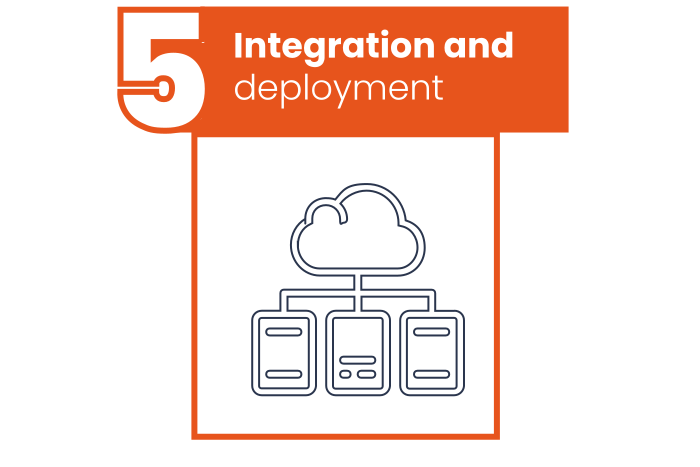
- The pipeline is configured so that tests are executed automatically.
- A static analysis is performed to validate that the code is error-free.
- The code is expected to only advance to subsequent stages without errors.
- The tests are executed according to the deployment schedule.
- The automated tests configured in the pipeline are carried out.
- The performance of each test case is monitored in real-time.
- The process is optimized through its execution at optimal times.
- Detailed reports are generated by scenario to enable quick actions.
- The execution of automated tests is continuously monitored.
- Scripts are reviewed and adjusted when failure patterns are detected.
- Scripts are optimized, and modules are restructured to enhance efficiency.
- It is sought that tests are aligned with the system’s evolution.

- A thorough analysis of the results of the entire cycle is carried out.
- Insights are generated that help improve the automation process.
- The lessons learned, and opportunities for improvement are documented.
- Feedback is provided to the teams involved to optimize the process.
Test automation is flying high
Airlines and the travel sector’s software tools, in general, tend to be highly complex, comprising ecosystems of products from different manufacturers that connect to multiple platforms and technologies, making regression testing particularly long and difficult to perform manually. This is where automation enables validating the entire interaction flow without disrupting the pace of new updates and feature releases.
This is a constantly evolving environment where aviation companies need to make quick changes to their systems, such as security updates, integrating new features, and urgent fixes, which are part of the business’s daily routine. In this context, airlines will need to embrace test automation sooner rather than later if they hope to remain competitive, attractive, and efficient.
If you want to know how test automation can take your airline to new heights, contact [email protected]
* Image by Design team on bebolder.co