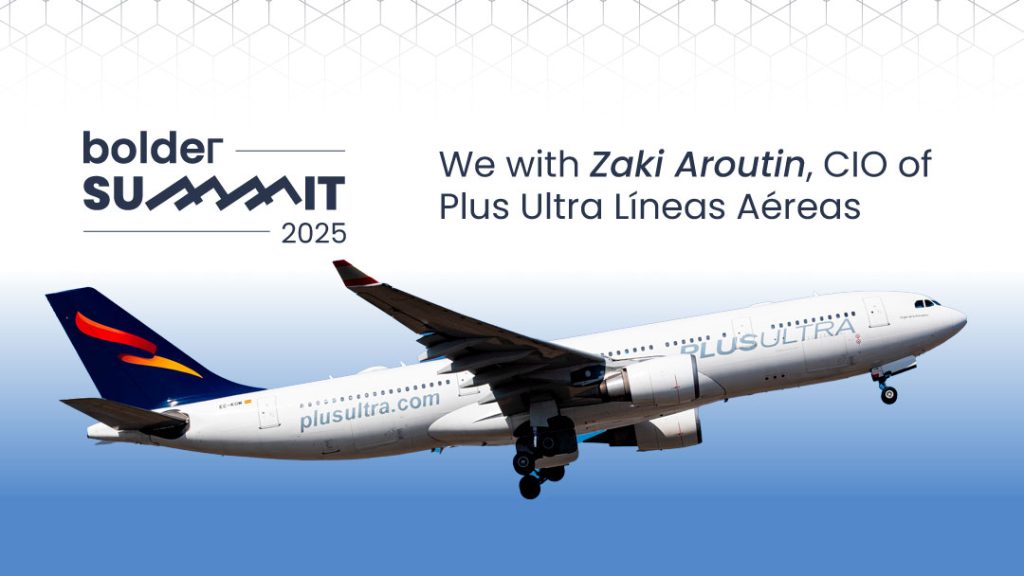
When an airline and a technology partner understand each other, innovation ceases to be mere rhetoric and becomes practical, yielding impressive results. At BolderSummit 2025, we spoke with Zaki Aroutin, CIO of Plus Ultra Líneas Aéreas. He told us about making difficult decisions in times of change, his technological vision applied to the aviation industry, and how co-creation makes a difference.
Zaki talks to us about technological solutions with “our feet on the ground,” decisions that translate into efficiency, safety, and a satisfactory passenger experience. His approach is practical and direct: when software understands the business, technology ceases to be a cost and becomes a competitive advantage.
Technology with a purpose
Zaki Aroutin doesn’t discuss technology in the abstract; he links it to the results that matter to an airline. With more than two decades of experience and currently serving as CIO of Plus Ultra, his starting point is clear: Each IT decision must support operational security, compliance, and a simpler passenger experience. Hence, he focuses on prioritizing essentials, automating repetitive tasks, and ensuring systems run at business speed.
This vision translates into method and leadership. Zaki insists on accurately establishing requirements, defining use cases in detail, and designing integrations that eliminate friction. He seeks teams and partners that understand the logic of the operation and can translate concrete problems into elegant, maintainable solutions. In this way, technology ceases to be a cost and becomes a practical advantage serving passengers and the operation.
Three complementary airlines
- Long-haul scheduled flights from Madrid and Tenerife to Latin America.
- ACMI/charter operations to meet the specific needs of clients.
- Cargo flights to expand its operational and revenue profile.
The pandemic as a turning point
Zaki took on the biggest challenge of his tenure just six months after arriving at Plus Ultra: the pandemic. A company with nearly 600 people, 100 % in-person, saw its operations drop from 100 to 0 in a matter of days. The response was immediate and pragmatic: activating remote work without the necessary infrastructure, implementing a corporate messaging system, strengthening internet connections, and securely deploying applications, amid a global equipment shortage.
The adjustment didn’t stop at IT. The airline handled an avalanche of refunds by creating an automated system with a small IT team and support from partners. At the same time, it operated repatriation flights from Asia to Spain, a decision that sustained revenue and generated pride in its social impact. From that time, lessons learned that today shape Zaki’s management: reacting quickly, integrating the essentials, and turning operational pressure into sustainable improvements.
Co-creation that understands and solves the problem
In Spain, an e-ticket is equivalent to an invoice; however, for tax purposes, many clients require an official invoice. More and more requests began arriving by mail, and since they were processed manually in the ERP, the process became unsustainable. It was then decided to automate the process to comply with tax regulations and gain efficiency.
In the co-creation process, Zaki highlights the work with be bolder: their professionalism, commitment, and, above all, their meticulous analysis, which established requirements, identified all use cases, and diagrammed and discussed them before development. This rigour ensured the project was streamlined and on schedule from day one.
The result was a web-based solution, connected to the reservation system to extract the necessary data and to the ERP to transmit the invoice to the tax agency, closing the end-to-end cycle. In Zaki’s words, the value wasn’t just in the code, but in the way they worked: understanding the problem, designing the right integrations, and executing with discipline.
Artificial Intelligence is among us and here to stay
For Zaki, artificial intelligence is already part of everyday life. It starts with the simple and useful: summarising emails and minutes, reviewing documents, and generating support content. Added to this is the automation of repetitive tasks through agents who execute workflows from start to finish, without fatigue or oversights, freeing up team capacity to resolve higher-value cases. The logic is pragmatic: use AI where it saves time, reduces errors, and accelerates response.
The IA’s next leap is in customer relations and revenue. LLM-powered chatbots enable true self-service, and more sophisticated models help forecast demand, improving occupancy and reducing no-shows. In pricing, AI streamlines monitoring of competitors’ rates, enabling timely responses and decision-making to increase margins and engagement.
Plus Ultra Green program, sustainability in action
For Zaki, sustainability isn’t secondary; it’s a daily operation. Under the Plus Ultra Green program, decisions are made with a focus on energy efficiency and CO₂ reduction: From how consumption is managed in flight and on the ground to the commitment to more modern aircraft. The focus is clear: industry standards and IATA environmental certifications that drive continuous improvement, compliance, and measurement across processes, the fleet, and suppliers.
Among other things, this discipline translates into technological actions such as:
- Digitizing documentation and internal workflows, eliminating paperwork, and speeding up processes.
- Acquiring equipment with sustainability certifications and aligning IT infrastructure with environmental standards.
The result: less administrative friction, greater efficiency, and sustainability integrated into technology decisions.
What's next: integration, speed, and experience
Zaki envisions an operation where AI and the integration of self-service channels with the internal systems that support the operation enable true self-service: Pricing decisions with minimal latency and better-optimized cabins. It’s not about adding tools, but rather orchestrating them so that the response to the customer and the market occurs in near real-time, to be measured in occupancy, no-shows, and margin. Based on this, three lines of progress are consolidated:
- AI-powered agents: Chatbots with LLM that resolve queries, sell tickets, offer ancillaries, and complete automatic check-in, closing the end-to-end flow.
- Cabin optimization: Models to increase load factor and reduce no-shows, fine-tuning inventory and allocation based on demand signals.
Pricing in (near) real-time: Systems that scan competitors’ fares by route to react quickly with pricing actions when the market changes.
Our clients’ vision is our vision
We thank Zaki Aroutin for sharing his vision and insights on technology in the airline industry. As with Plus Ultra Líneas Aéreas, we are ready to turn your vision into concrete results. We rigorously analyse requirements, clearly define use cases, and design integrations that eliminate friction between self-service channels and internal systems.
Let’s meet to understand your priorities, map critical processes, identify the connections you need, and agree on impact metrics. From there, we will make an action plan with concrete milestones to deliver value to you quickly.
Let’s take the first step and build the future of your airline together.
[email protected]
* Image by Design team on bebolder.co